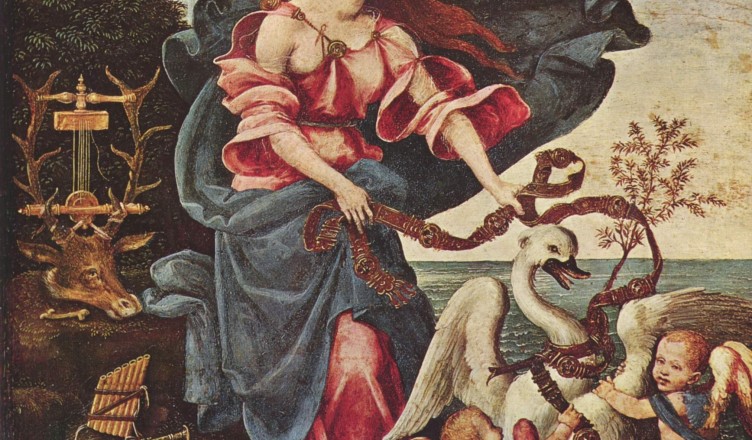

What do artworks say? What do they represent? Does the artist sometimes hide a deeper message within the superficial image? In the past, painters drew images and codes from a vast repertoire of symbols, that their predecessors had used. these symbols were understood by their contemporaries, but we modern viewers no longer know how to interpret hem. They are an integral part of the artwork’s structure; if we cannot decode them, we cannot comprehend the story the images tell and the message they want to convey.
MEDIEVAL thought reorganised the major symbolic codes of antiquity into a new religious and teleological conception of the world, imposing a clear dichotomy between the principles of good and evil, according to which the principal figures of the Christian pantheon were assigned their proper place: Christ, the Virgin, the angels, and the saints on the one hand, the devil and his emissaries on the other. Romanesque art is rich in symbols drawn from the past, some immediately accessible to our contemporary world, others categorized as demonic and monstrous because they have become inscrutable with the passing of time.
The RENAISSANCE saw a revival of classical culture, brought about by the reading and translation of ancient manuscripts by the humanists and their dissemination via the newly invented printing press. These texts restored to the West some very ancient cultural traditions, dating as far back as the Mesopotamian, Indo-Iranian, and Egyptian civilizations.
The “symbolic images” of the FIFTEENTH AND SIXTEENTH CENTURIES were profoundly influenced not only by the myths of Graeco-Roman antiquity but also by Platonic philosophy and the Hermetic and esoteric traditions derived from the Jewish Kabbalah. In this intellectual environment, the work of art was seen as a “second nature” and a new cosmogenesis, akin to the alchemical transmutation of matters. Renaissance artists therefore used alchemical symbols in their works to a limited circle of “initiates” (patrons, humanists, painters, and literati), a shared body of important moral and intellectual values.
During the SEVENTEENTH CENTURY, much of the iconographic repertory was collected in a series of treatises and dictionaries, which the artists used to help them give clear and efficient expression to the most commonly used symbols and their corresponding meanings. Over the course of the seventeenth and eighteenth centuries, however, artists began to apply these codes in an almost mechanical fashion: the images were gradually emptied of their deeper meanings and turned into simple didactic icons.
The visionary painting of the late eighteenth century, the culture of ROMANTICISM, and nineteenth-century SYMBOLISM reasserted an antinaturalist conception of art that brought together figures and meanings drawn from the imagination and the unconscious. Not until the twentieth century, however, did certain artistic trends such as Surrealism link their aesthetic and creative principles back to the esoteric tradition of the past.
MEDIEVAL thought reorganised the major symbolic codes of antiquity into a new religious and teleological conception of the world, imposing a clear dichotomy between the principles of good and evil, according to which the principal figures of the Christian pantheon were assigned their proper place: Christ, the Virgin, the angels, and the saints on the one hand, the devil and his emissaries on the other. Romanesque art is rich in symbols drawn from the past, some immediately accessible to our contemporary world, others categorized as demonic and monstrous because they have become inscrutable with the passing of time.
The RENAISSANCE saw a revival of classical culture, brought about by the reading and translation of ancient manuscripts by the humanists and their dissemination via the newly invented printing press. These texts restored to the West some very ancient cultural traditions, dating as far back as the Mesopotamian, Indo-Iranian, and Egyptian civilizations.
The “symbolic images” of the FIFTEENTH AND SIXTEENTH CENTURIES were profoundly influenced not only by the myths of Graeco-Roman antiquity but also by Platonic philosophy and the Hermetic and esoteric traditions derived from the Jewish Kabbalah. In this intellectual environment, the work of art was seen as a “second nature” and a new cosmogenesis, akin to the alchemical transmutation of matters. Renaissance artists therefore used alchemical symbols in their works to a limited circle of “initiates” (patrons, humanists, painters, and literati), a shared body of important moral and intellectual values.
During the SEVENTEENTH CENTURY, much of the iconographic repertory was collected in a series of treatises and dictionaries, which the artists used to help them give clear and efficient expression to the most commonly used symbols and their corresponding meanings. Over the course of the seventeenth and eighteenth centuries, however, artists began to apply these codes in an almost mechanical fashion: the images were gradually emptied of their deeper meanings and turned into simple didactic icons.
The visionary painting of the late eighteenth century, the culture of ROMANTICISM, and nineteenth-century SYMBOLISM reasserted an antinaturalist conception of art that brought together figures and meanings drawn from the imagination and the unconscious. Not until the twentieth century, however, did certain artistic trends such as Surrealism link their aesthetic and creative principles back to the esoteric tradition of the past.